There are many steps required for closing international corporate deals. One step that may seem straightforward is retrieving documents such as good standing certificates (or the country equivalent) and formation/ charter documents. However, when dealing with different jurisdictions that have their own legal systems and languages, it can be challenging for legal counsel to perform this due diligence work for their clients outside the U.S. in a timely and efficient way.
In this article, we’ll review some of the many intricacies involved in fulfilling international document retrievals as part of the overall legal due diligence process.
1. Document naming convention differs across jurisdictions
An institution that exists in one legal system may not exist in the other. The international equivalents of documents and filings have different names and are governed by different laws than in the U.S.
For example, many governments don’t have the concept of “good standing.” The equivalent of a good standing certificate might be a “certified extract,” “certificate of existence,” or “HRB certificate” as it’s called in Germany, but none of these may officially convey the meaning of good standing as it’s known in the U.S. The benefit of having an experienced provider is that you can obtain the help you need to determine what documents may be available to meet your requirement for a good standing.
Another document that has different nomenclature is “articles of incorporation”, which can be called “charter documents,” “memorandum of association,” and more. What is commonly known as a “bring down letter” is referred to in other countries as a “comfort letter,” “verbal status report,” or “profile report.”
Outside the U.S., an “apostille certificate” is commonly known as an “authentication certificate” or simply “legalization.”
2. Supplemental documents may be required
It’s also important to note that when searching for a U.S. equivalent document in another country, the information required may not match one-to-one and additional documents may be needed, adding time and complexity to the retrieval process.
For example, when obtaining copies of a company’s formation or incorporation document these may not always reflect amendments, changes, and appointments. Instead, those documents must be ordered separately. In Germany, things are a little different and this information is included in the HRB certificate (equivalent to a certificate of good standing).
Even within the same country, a U.S. equivalent document can differ from city to city or state to state. In India, for instance, the nature of a certificate of good standing can vary depending on whether the business is in New Delhi or elsewhere.
Health checks and credit reports can also be inconsistent across countries, with the information differing based on what’s available in each jurisdiction. Similarly, litigation and judgement search reports can be different. In the Cayman Islands, a popular jurisdiction for incorporation, reports will include both pending litigations and judgments, whereas in the UK, these reports must be ordered separately.
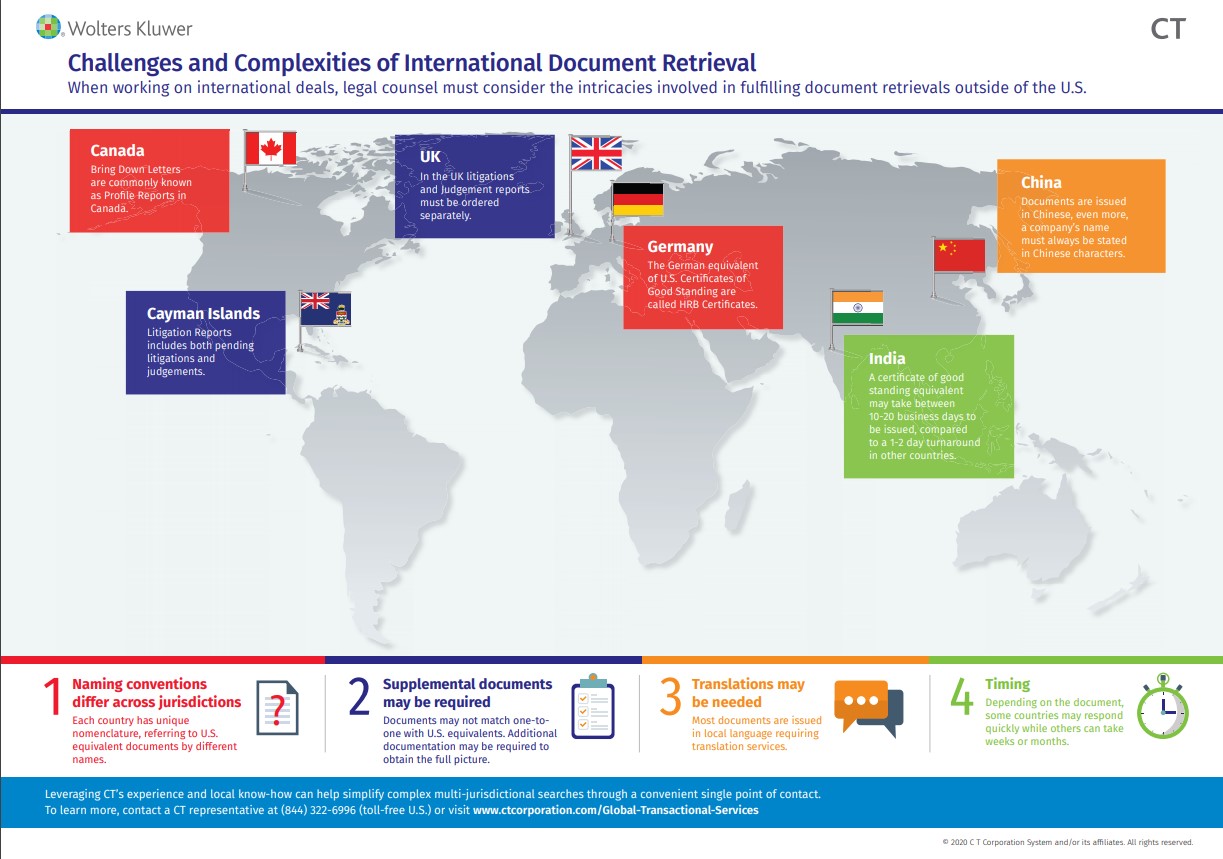
Click to enlarge
3. Translations may be needed
Legal translations can add to the complexity of a project in two ways. First, documents are often issued in the local language. Unless your clients know the language of the country of origin, they will not be able to confirm the contents of the document and will require a translated version. Second, foreign agencies and jurisdictions often have unique requirements for how a translation is to be done and by whom. It is important to consider working with a provider who can provide translation services when required.
Furthermore, some countries require that the company name be represented in their language, no matter the company’s country of origin. In China, for example, the company name must be stated in Chinese characters.
Some countries are more accommodating. In the Netherlands, certificates of good standing are automatically issued in English. And in Japan and Taiwan, copies of good standing documents are provided in English alongside the official local language document.
Expert Insight: Working on clients’ international deals can bring a host of unexpected challenges. Listen to this podcast: Best Practices for Attorneys Conducting International Transactions and get insights from CT’s global experts.
4. Watch their clock, not yours
Some countries have dramatically different approaches to doing business than in the U.S. This can be most apparent in their timelines for responding to requests. Depending on the document, some countries may respond quickly while others can take weeks or months.
In India, your clients can count on at least 10 to 20 business days for a good standing equivalent, compared to a one to two-day turnaround in other jurisdictions. In Canada, timelines can vary depending on the province in which the search is being done. In some territories, it could be the same day or one to two days at a maximum, while in others, such as the northwest territories, it can take between one and two weeks.
Navigate the intricacies
Working on international deals can bring a host of unexpected challenges that can impact your clients’ deal timeline. Understanding the complexities and nuances of document retrieval outside of the U.S. — a key part of the overall due diligence that legal professionals and advisors complete for their clients — is critical. Working with a trusted partner and leveraging their know-how and local expertise can help simplify complex multi-jurisdictional searches through a single point of contact and is key to your and your client’s success.
To learn more about how CT’s Global Transactional Services can help you better manage your client’s international needs, contact a CT representative at (855) 444-5358 (toll-free U.S.).